2026 GRFP Sample Statements
My funded 2026 NSF Graduate Research Fellowship Program (GRFP) sample statements: a personal statement and a neuroscience research statement, shared in full.
Personal Statement
Page 1 of 3
In a dimly lit Broome County courtroom, I watched a fifteen-year-old defendant struggle to explain his actions. But as I pored through his case file during my internship at the County Attorney’s Office, a pattern emerged. His decisions weren’t random—they reflected an internal logic shaped by his environment and the rewards and punishments he had learned to expect. He had extracted rules from those experiences and applied them, even when those rules proved maladaptive.
This unsettled me. Growing up as the perpetual “new kid,” constantly moving between schools, I too had learned to infer underlying rules—what behaviors earned acceptance, which led to isolation. Each relocation demanded that I decode new social structures and adapt. Yet while my ability to generalize fostered adaptation, his led to rigid behavior patterns that failed outside their original context. What determines whether we extract generalizable rules that transfer across contexts or become trapped by rigid patterns learned from limited experience?
The answer, I realized, lay not in behavioral analysis through political science - my initial major - but in understanding how neural circuits implement flexible generalization. This question redirected my trajectory: from studying collective behavior through law and politics to investigating the neural mechanisms underlying adaptive learning through systems neuroscience and machine learning.
Intellectual Merit
With limited neuroscience resources at my undergraduate institution, I pursued a physics major to develop the quantitative tools needed to study neural computation. Adding this major in my junior year, taking 5 winter and summer courses and self-studying through online lectures, this dedication was recognized through my induction into Sigma Pi Sigma, the national physics honor society requiring faculty nomination and ranking in the top third of the class—an achievement that validated my unconventional path into the sciences.
To gain hands-on computational experience, I joined Prof. Kolmogorov’s computational material science lab as an undergraduate research assistant, where I applied neural networks (NN) to predict thermodynamic stability of chemical compounds. I researched and compiled datasets on alkali-tin compositions, trained NN models to identify lowest free-energy configurations, and analyzed predictions. Collaborating with a graduate student, we were tasked with deriving a theoretical correction term accounting for substitutional defects - a crucial factor in predicting thermodynamic stability. When initial approaches failed, we synthesized insights from statistical thermodynamics, calculus, and combinatorial theory, iterating through derivation barriers until we obtained the correction term. This derivation enabled us to identify two previously unsynthesized structures that were subsequently experimentally confirmed. This work resulted in two co-authored publications (Publications, Documentation, & Creative Works) and established my foundation in computational modeling, data analysis, and conducting first-principles theoretical derivations. In recognizing that both artificial and biological networks learn structure from experience reinforced my commitment to integrating machine learning with neuroscience.
The summer after graduating summa cum laude, I pursued an independent project modeling how genomic constraints shape sensory perception under Prof. Kolmogorov’s guidance. I built a convolutional neural network (CNN) to analyze olfactory receptor promoter sequences and predict singular gene expression, exploring how stochastic gene choice might arise from genomic architecture. While the CNN I developed and optimized ultimately achieved insufficient predictive accuracy for publication, this independent project was invaluable: it taught me to critically evaluate the input data used for the model, how to properly plan the stages of a model’s development, and how to iterate through optimization strategies. More importantly, this project immersed me in neuroscience literature on sensory processing, taught me MATLAB programming from scratch, and demonstrated that I could independently design and execute computational research projects—skills that would define my subsequent work.
After this summer, pandemic-related disruptions led to limited research hiring in systems neuroscience. Rather than delay my trajectory, I joined Thorlabs, a leading optical imaging company, as an Applications Engineer—a position that would provide hands-on technical training with the very tools I would later use in my research. I provided global technical support for researchers designing imaging experiments, troubleshooting complex optical setups and gained expertise in lasers, fiber optics, and microscopy systems. This role developed my ability to communicate technical concepts across disciplines—explaining optical physics to biologists and experimental constraints to engineers. While this role provided invaluable technical expertise, I found myself drawn back to academic research: I missed
Page 2 of 3
the sustained exploration of complex questions, the collaborative problem-solving, and the deeper intellectual engagement that research provides. This clarity, combined with my specialized training in 2P imaging systems, made me uniquely qualified for a position at NYU’s Neuroscience Institute—where I could finally bring together my physics background, computational skills, and optical expertise to investigate how neural circuits extract structure from experience.
At the NYU Neuroscience Institute, I joined the Rinberg and Shoham labs to investigate a fundamental problem in sensory processing: how neural circuits extract relevant signals from noisy, dynamic backgrounds—a question related to my interest in how the brain identifies meaningful patterns in complex environments. Leveraging my Thorlabs training, I was immediately able to contribute by optimizing our laboratory’s 2P microscope design. I redesigned optical pathways, custom-fabricated components using 3D printing, and aligned the system to achieve optimal laser transmission. Having gained proficiency in 2P microscope design and operation, I became the primary user of the Rinberg lab’s 2P setup and created a comprehensive 200-page manual documenting its procedures and software as they related to each individual project being conducted in the lab. This standardization streamlined protocols and reduced training time for new users.
As part of my own project in the Rinberg lab, working at the interface of behavior and neural recording, I focused on the olfactory system’s ability to detect specific odors amid changing background scents. Using optogenetics to selectively activate individual glomeruli (the first processing stage of olfactory information) while simultaneously imaging downstream mitral cell responses with 2P microscopy, I developed a Go/No-Go behavioral paradigm to test whether mice could detect these precise neural activations at different phases of the inhalation cycle. This approach allowed me to address whether timing of neural activation—relative to the natural breathing cycle—affects sensory perception, addressing a longstanding question in olfactory neuroscience. Through months of behavioral training, I learned that mice consistently adopt the most efficient strategy to complete a task - whether or not it aligns with the experimenter’s intended question. When mice initially exploited unintended cues to solve the task, I systematically redesigned the paradigm, testing multiple approaches until mice revealed the intended information from their behavior. Planning, executing, and refining this experiment taught me the essential skills of experimental iteration: adapting behavioral paradigms when initial approaches failed and reshaping hypotheses as the data revealed unexpected patterns, maintaining persistence through setbacks. Every couple of months, I presented my progress in lab meetings, learning to synthesize complex multimodal data (imaging and behavior) into a clear and cohesive narrative to solicit meaningful feedback and advise on future directions and refinements. Over two and a half years at NYU, I performed and trained others in more than 60 cranial window surgeries, conducted longitudinal imaging in 17 trained mice, and maintained detailed documentation of my work in a GitHub repository (Publications, Documentation, & Creative Works) to support the Ph.D. student who succeeded me on the project.
These experiences led to my acceptance into Cornell’s Neurobiology and Behavior Ph.D. program, where I now work in the lab of Prof. Weinan Sun, studying how the hippocampus and prefrontal cortex support learning and memory by forming internal models of the world. Our lab combines cutting-edge 2P-RAM imaging—capable of recording from thousands of neurons simultaneously—with computational modeling, integrating the interdisciplinary skills I developed through physics, computational research, optical engineering, and systems neuroscience. My current project examines how neural circuits extract abstract task structure to guide behavior in novel contexts through generalization. This work brings me full circle: from observing maladaptive pattern learning in the courtroom to repeatedly having to adapt to new environments as a child, I now study how the brain builds cognitive maps—internal representations that capture the abstract structure of the environment—enabling flexible generalization across contexts.
Future Goals: My long-term goal is to lead an independent lab to understand how neural circuits support flexible learning. To achieve this, I will complete my Ph.D. at Cornell studying biological and artificial intelligence, pursue postdoctoral training in dynamical systems modeling and machine learning, and establish a faculty position at a research-intensive institution. As a principal investigator, I will explore how biological systems achieve data-efficient learning and what principles from the brain can inspire more robust machine-learning architectures. My lab will emphasize training diverse interdisciplinary scientists, developing open-source computational tools, and engaging the public through education and outreach.
Page 3 of 3
Broader Impacts
My commitment to broadening participation in STEM stems from my own unconventional path. As a student who discovered neuroscience through physics and political science, I understand how access, mentorship, and representation shape scientific identity. I have worked to expand these opportunities through teaching, mentorship, and outreach at every stage of my training.
Promoting Scientific Literacy and Broadening STEM Participation
Past Contributions: As an undergraduate Lead Lab Instructor for calculus-based Physics II, I independently taught classes of 16 students on a weekly basis for 1.5 hour durations, guided students through mathematical problem-solving, and demonstrated real-world applications. I also volunteered for my university’s Physics Outreach Program, visiting three local schools a semester to teach scientific concepts through hands-on demonstrations. These experiences strengthened my ability to explain complex ideas to diverse audiences from first principles to foster collaborative learning. Future Contributions: I am developing a four-session course through Cornell’s GRASSHOPR Program, “Exploring the Brain Through Light: Physics and Neuroscience in Action.” The course introduces the interdisciplinary nature of modern science as students learn how two-photon imaging and optogenetics allow researchers to visualize and control neural circuits with precision, culminating in a guided walkthrough of a real neuroscience experiment that connects physics, biology, and engineering to the study of behavior and cognition.
Advancing Teaching, Training, and Learning Through Mentorship
Past Contributions: After graduation, I continued supporting scientific pursuits across multiple contexts. At Thorlabs, I provided global technical support for researchers daily, developing troubleshooting protocols for microscopy projects. At NYU’s Neuroscience Institute, I trained students (4), research assistants (2), and visiting scientists (2) in chronic cranial window surgeries, adapting my approach to each trainee’s experience level. These experiences taught me that effective mentorship combines patient technical instruction with collaborative problem-solving. Future Contributions: In Dr. Sun’s lab, I will recruit two to three undergraduate research assistants through Cornell’s undergraduate research programs, including the Meinig Family Cornell National Scholars Program and the Leadership Alliance Summer Research Early Identification Program (SR-EIP), which support underrepresented students in STEM. I will train these students in two-photon microscopy, computational analysis, and mouse behavioral training, involving them in all research stages - from experimental design to data analysis and manuscript preparation - providing comprehensive training in modern systems neuroscience.
Enhancing Infrastructure and Broadening Dissemination
Past Contributions: Understanding that scientific progress depends on accessible resources, I compiled a comprehensive GitHub repository at NYU documenting experimental methods, Python code for image processing and behavioral analysis, and future research directions. This repository is now accessed and contributed to by the Ph.D. student continuing my project. Future Contributions: I will maintain my GitHub page and upload code developed for analyzing large-scale calcium imaging data and implementing machine learning models, making these tools available to the broader neuroscience community. Additionally, I plan to publish results in open access journals and upload early drafts to bioRxiv, facilitating timely advancement of scientific knowledge across academia and AI industries.
The NSF GRFP grant would provide the intellectual freedom and funding flexibility to fully realize these broader impacts: dedicating time to develop and refine my GRASSHOPR curriculum, recruiting and training undergraduate researchers without being constrained by grant budgets, and investing effort in creating well-documented open-source tools rather than rushing to next publication. This fellowship would allow me to prioritize mentorship, teaching, and community-building alongside my research—establishing habits that will define my future laboratory.
My path from a small-town courtroom to Cornell’s Neuroscience program has been unconventional—spanning political science, physics, industry, and now cutting-edge systems neuroscience. This diverse training uniquely positions me to bridge computational and experimental methods to approach a question that has driven me since childhood: how do neural circuits extract patterns that enable us to thrive in changing environments? By investigating the neural basis of generalization - a capacity central to both human cognition and machine learning systems - I aim to advance our understanding of how biological systems learn flexibly from experience.
Research Statement
Page 1 of 2
Intelligent behavior relies on recognizing structure in the environment. Rather than treating each situation as unique, the brain extracts rules that link diverse experiences – a process called generalization. This ability depends on cognitive maps: internal representations encoding abstract relationships between environmental features and behavioral outcomes, enabling flexible transfer to novel situations1. Cognitive map formation involves a division of labor across brain regions: the hippocampus builds maps of specific task environments and behavioral consequences2, while the medial prefrontal cortex (mPFC) encodes abstract structures that generalize across contexts3. Yet, how mPFC neural population activity reorganizes during learning to extract these abstract structures remains uncharacterized at the cellular level.
I propose to combine large-scale, cellular-resolution imaging with machine learning to characterize how mPFC neural population dynamics evolve during learning (Aim 1) and identify the computational principles underlying biological generalization (Aim 2). Drawing on my experience in physics, computational modeling, optical engineering, and systems neuroscience, I am uniquely equipped to integrate advanced imaging with quantitative methods to address how prefrontal circuits achieve structured generalization.
Intellectual Merit
Currently, researchers are attempting to understand PFC function during generalization by studying well-trained animals using electrophysiological recordings or limited imaging approaches. Progress has been hindered as electrophysiology lacks the ability to track stable cell identity across weeks of learning, while conventional imaging has typically captured only well-trained neural activity, missing critical dynamics. Using the state-of-the-art two-photon random access mesoscope (2PRAM)4 in the Sun Lab at Cornell, I will longitudinally record from thousands of stably identified mPFC neurons (Fig. 1a) to track population dynamics over several weeks as animals learn to generalize task structure across sensory modalities (Fig. 2; Aim 1). This cross-modal design tests whether mPFC encodes abstract task rules versus sensory-specific information. Through an existing collaboration with Prof. Kevin Ellis (Cornell Computer Science)5, I will train a machine learning model to identify the computational principles underlying mPFC encoding strategies (Aim 2). Hypothesis: the mPFC will encode both abstract structure and modality-specific information through distinct subpopulations, producing a spectrum of tuning properties with some neurons showing modality-invariant responses while others retain sensory specificity (Aim 1). Computational models with intermediate network sparsity will best replicate these mPFC representations across learning stages, providing insight into the mechanisms underlying biological generalization (Aim 2).
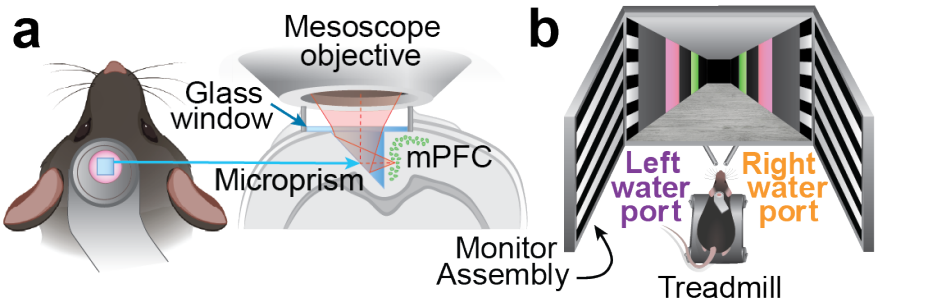
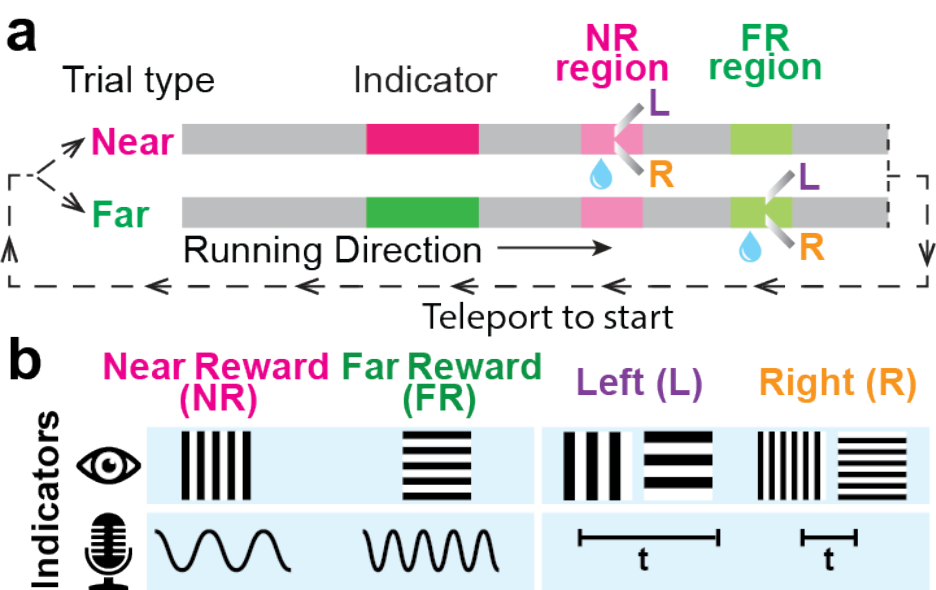
Aim 1. Characterize population dynamics in mPFC during learning and generalization. Head-fixed transgenic mice expressing calcium indicator GCaMP8s will navigate a linear virtual reality corridor while I perform 2P-RAM imaging of mPFC activity through a chronic microprism implantation (Fig. 1)6. I will train mice on tasks with identical abstract structure (Fig. 2a) but different sensory modalities: vision and audition (Fig. 2b). In the visual task, stripe orientation (vertical vs. horizontal) determines reward location (near vs. far) while pattern width (thick vs. thin) determines lick direction (left vs. right). In the auditory task, tone pitch (low vs. high) determines reward location while tone duration (long vs. short) determines lick
Page 2 of 2
direction, with visual displays disabled. After learning the initial task, mice will learn the task in the opposing sensory modality. I will use dimensionality reduction techniques (UMAP, Γ-VAE7) and representational similarity analysis8 to track population reorganization across learning stages. Hypothesis: mPFC will encode both abstract structure and modality-specific information through distinct subpopulations. This predicts a spectrum of tuning properties which evolve over the course of the learning process, with some neurons showing modality-invariant responses while others retain sensory specificity. Using generalized linear models3, I will decode abstract vs. sensory contributions for each cell, revealing which task dimensions merge first during learning. If cross-modal transfer is incomplete, I will examine intermediate training stages to identify when and how modality-specific representations emerge, testing whether additional training promotes abstraction. Guaranteed outcome: this approach will provide the first large-scale, cellular-resolution characterization of prefrontal population dynamics during cross-modal generalization, establishing foundational principles for how neural circuits implement flexible learning.
Aim 2. Decode task structure from mPFC dynamics using machine learning models. To identify the computational principles underlying cross-modal generalization in mPFC, I will leverage existing collaborations between Cornell’s Neurobiology and Computer Science departments5. I will train a multimodal recurrent neural network (RNN) on the same task structure presented to the mice (Fig. 2) using visual or auditory stimulus input to predict output behavioral choices (reward location, lick direction). I will analyze the representations learned in the mPFC and track alignment of recorded neural activity (Aim 1) with learned model representations (Aim 2). RNNs are particularly suited for this investigation because their recurrent dynamics flexibly implement context-dependent transformations9 - the core computation required for this task. I will systematically vary network hyperparameters (learning rate, connectivity strength, input representations) to identify regimes replicating mPFC learning stages. Hypothesis: network sparsity will be the critical parameter controlling cross-modal generalization capabilities. Drawing on recent findings that soft winner-takes-all (sWTA) mechanisms promote decorrelated cognitive maps2, I will modulate sparsity by systematically varying sWTA inhibition strength. Critically, mPFC and hippocampus employ distinct representational strategies. While the hippocampus exhibits strong global inhibition driving completely separated representations for similar contexts2, the mPFC exhibits weaker inhibition and maintains overlapping, distributed representations even for distinct task states10. This predicts that optimal mPFC-like representations will occupy an intermediate sparsity regime - enabling both abstract structure extraction and modality-specific encoding. Guaranteed outcome: I will produce a publicly available computational framework and associated dataset to serve as a benchmark enabling the comparison of various artificial neural network models of mPFC abstraction.
Broader Impacts
Understanding prefrontal mechanisms for data-efficient generalization directly addresses a critical challenge in AI development: despite massive datasets and computational resources11,12, current AI systems exhibit "jagged intelligence" - excelling at complex tasks while unpredictably failing at simpler ones that lie just outside the training distribution. This project—a collaboration between the Neuroscience and Computer Science departments at Cornell - exemplifies interdisciplinary approaches crucial for American leadership in AI. I will advance open science by making all code and data available on GitHub, publishing in open-access journals, and uploading preprints to bioRxiv, facilitating rapid knowledge transfer across academia and AI industries. To broaden STEM participation, I am developing a four-session course through Cornell’s Graduate Student School Outreach Program (GRASSHOPR) introducing neuroscience and microscopy concepts to local middle and high school students (Personal Statement). To support this project in the Sun lab, I will recruit two to three undergraduate researchers annually through programs supporting underrepresented students (Personal Statement), providing comprehensive training in two-photon microscopy, computational analysis, and behavioral neuroscience - mentoring them through all research stages from experimental design to manuscript preparation.
References: [1] E. C. Tolman, Psychol. Rev. (1948). [2] W. Sun, et al., Nature (2025). [3] M. El-Gaby, et al., Nature (2024). [4] N. J. Sofroniew, et al., eLife (2016). [5] A. Noviello, et al., arXiv preprint (2025). [6] R.J. Low, et al., Proc. Natl. Acad. Sci. U.S.A. (2014). [7] J. Z. Kim, et al., arXiv preprint (2024). [8] H. Nili, et al., PLOS Comput. Biol. (2014). [9] V. Mante et al., Nature (2013). [10] M. Rigotti, et al., Nature (2013). [11] J. Kaplan, et al., arXiv (2020). [12] OpenAI, "Announcing The Stargate Project" (2025).